Ancient Rock Art Found in Mexico Spans 4,000 Years
By Darren Smith, Arts Reporter
April 17, 2026
Archaeologists in central Mexico have uncovered a remarkable collection of ancient petroglyphs and cave paintings at the El Venado site in Hidalgo state, some dating back more than 4,000 years. The discovery, made during rescue archaeology for a new high-speed passenger rail line between Mexico City and Querétaro, reveals a long continuum of human artistic expression in the region near the ancient Toltec capital of Tula.
Mexico’s National Institute of Anthropology and History (INAH) documented 16 graphic elements, including both carved petroglyphs and painted pictographs, on two rocky slopes overlooking the Tula River and La Requena Dam. The artworks, located near the communities of San José Acoculco and Benito Juárez, feature anthropomorphic figures with detailed clothing and ornaments, possible animal forms such as deer, faces with elaborate headdresses, and motifs that may relate to later Mesoamerican deities like Tláloc, the rain god.
Stylistic analysis indicates the pieces were created across a vast timespan. The oldest faded paintings likely belong to prehistoric hunter-gatherer societies from the Archaic period, while later examples connect to the Mesoamerican Postclassic era (approximately A.D. 900–1521), encompassing Toltec and Aztec influences. This chronological depth offers rare insight into cultural continuity in central Mexico, where rock art sites have been noted since the 1970s but new details emerged only through intensive survey work.
The find highlights the value of salvage archaeology in balancing infrastructure development with heritage preservation. When initial surveys identified the rock art on steep cliffs previously difficult to access, authorities rerouted an 8-kilometer section of the rail line to protect the site. INAH specialists used non-invasive documentation techniques, including detailed photography and mapping, to record the fragile images without damage.
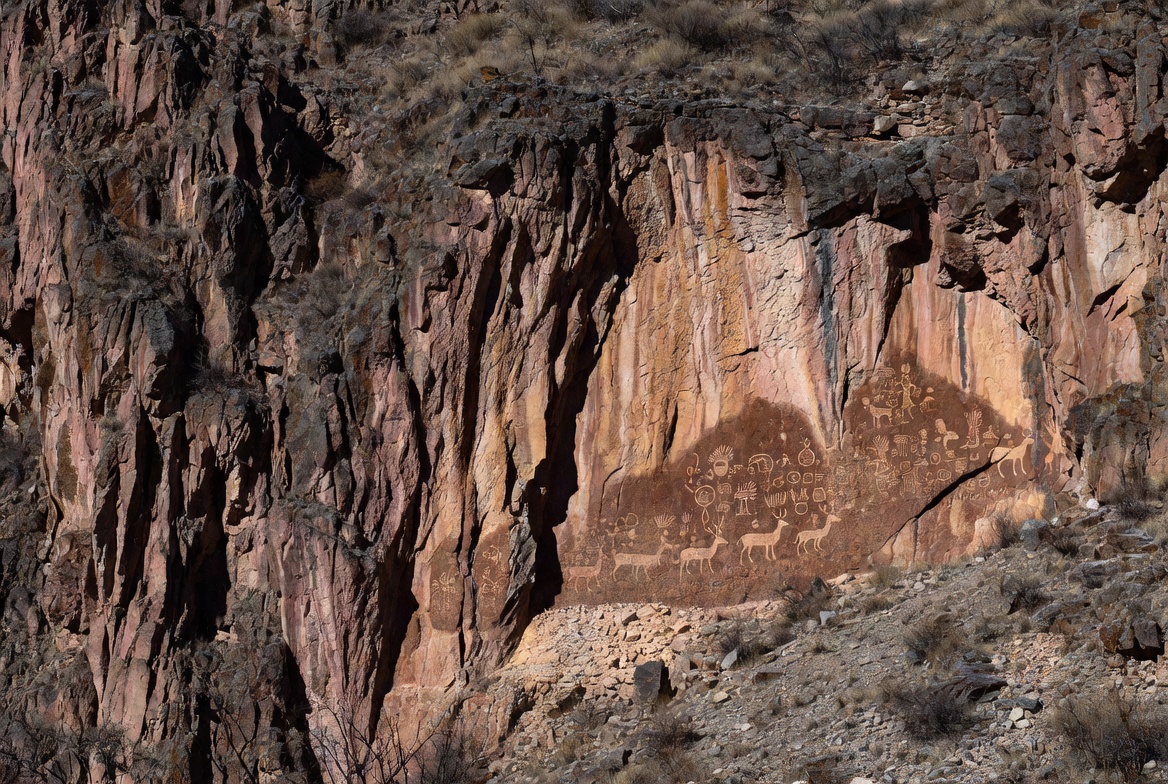
One image shows a rocky cliff face at El Venado with faint petroglyphs visible on the stone surface.

Another captures the rugged terrain of the site, where archaeologists conduct careful documentation amid natural vegetation.

A close-up view reveals intricate carved and painted figures on the rock walls, demonstrating the skill of ancient artists.

An archaeologist is seen working in the challenging landscape, illustrating the fieldwork involved in the discovery.

Experts note that some paintings employ mineral pigments and techniques like pointillism, while petroglyphs show precise incisions into the rock. Human-like figures often appear with distinctive attire, suggesting ritual or social significance. The presence of possible deer imagery may point to hunting or symbolic themes common in early Mesoamerican worldviews. Specific motifs include figures with shields, weapons, and regalia associated with Tláloc.
This discovery adds to growing evidence of sophisticated artistic traditions in the region long before the rise of major civilizations like the Toltecs. The El Venado site lies within a broader cultural landscape tied to Tula, known for its monumental architecture and influence on later Aztec society. Researchers believe the rock art may reflect shared symbolic systems, including concepts of cosmology, fertility, and the natural world that persisted across millennia.
The rail project, part of Mexico’s ongoing infrastructure initiatives, has prompted multiple archaeological interventions. In addition to the rock art, recent salvage work nearby uncovered a Toltec-era altar with human remains, underscoring the area’s layered history. INAH officials emphasize that such findings demonstrate how modern development can coexist with cultural stewardship when proper protocols are followed.
Preservation challenges remain significant. Many images are partially faded due to natural erosion and exposure, requiring careful monitoring and potential conservation measures. Digital recording will allow future study and public appreciation without further risking the originals.
The El Venado finds contribute to broader understanding of pre-Columbian visual arts in Mexico, joining other notable rock art traditions such as the Great Murals of Baja California. They remind us that artistic expression has long served as a bridge across time, preserving beliefs and identities of Indigenous peoples.
As analysis continues, INAH plans further studies to refine dating and interpret the iconography in collaboration with local communities and Indigenous groups who regard the area as a living cultural sanctuary.
Darren Smith is an Arts Reporter at Art Chain News covering contemporary art, digital art and NFTs, body art, and the intersections between these fields.
