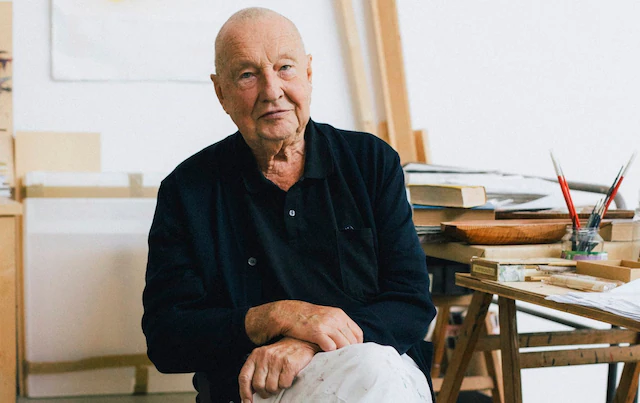
Georg Baselitz: Legacy of a Neo-Expressionist Titan
By Darren Smith, Arts Reporter
April 30, 2026
Georg Baselitz, the German artist whose raw, confrontational works helped redefine postwar painting and whose signature inverted canvases challenged viewers worldwide, died peacefully today at the age of 88.
Born Hans-Georg Bruno Kern on January 23, 1938, in the Saxon village of Deutschbaselitz, Baselitz came of age amid the ruins of Nazi Germany and the division of his homeland. His early life under two dictatorships forged an artistic rebellion that would echo through six decades of painting, sculpture, printmaking and drawing.
“I was stupid. I was uneducated, but I was a rebel,” he once recalled of his youth. Expelled from the Academy of Fine and Applied Art in East Berlin for “social and cultural immaturity,” he fled to West Berlin in 1957, adopting the name Baselitz in homage to his birthplace. There, he immersed himself in the traditions of German Expressionism while rejecting the dominant trends of abstraction.
His breakthrough came in the early 1960s with provocative figurative works that confronted Germany’s traumatic past. The 1963 exhibition of his Die Große Nacht im Eimer (Big Night Down the Drain)—depicting a masturbating figure—led to police confiscation on obscenity charges, cementing his reputation as an enfant terrible. By the mid-1960s, his celebrated Hero paintings portrayed fractured, monumental male figures as wounded ideals, raw with thick impasto and emotional intensity.
In 1969, Baselitz made his most radical gesture: he began painting and displaying his subjects upside down. “An object painted upside down is suitable for painting because it is unsuitable as an object,” he explained. This inversion was never mere gimmickry. It forced audiences to confront the act of looking itself, prioritizing painterly gesture, color, and surface over narrative or easy recognition. Works like Der Wald auf dem Kopf (The Forest on Its Head) exemplified this shift, liberating representation from content while echoing the disorientation of a generation grappling with historical guilt.

Baselitz’s influence extended beyond painting. His roughly hewn wooden sculptures, often monumental and fragmented, carried the same visceral energy. He represented Germany at the Venice Biennale multiple times and participated in several documenta exhibitions. Major retrospectives followed at institutions including the Solomon R. Guggenheim Museum in New York (1995), the Royal Academy of Arts in London (2007), and the Centre Pompidou in Paris (2021–22). In 2004, he received the prestigious Praemium Imperiale for painting.
Even in later decades, Baselitz remained prolific, producing large-scale portraits and continuing to innovate with new series of works. A planned major exhibition of his latest paintings at the Fondazione Giorgio Cini in Venice, tied to the current Biennale, now stands as a poignant farewell. His longtime gallery, Thaddaeus Ropac, described him as “a titan of contemporary painting, sculpture, drawing and printmaking” whose influence on fellow artists remains profound.

Critics and peers alike note Baselitz’s complicated legacy. His work unflinchingly addressed German identity, memory, and the human condition, yet he occasionally courted controversy with outspoken remarks. What endures is the power of his visual language—a bridge between Expressionism’s emotional directness and the conceptual provocations of contemporary art. His donations and gifts, including pivotal 1969 inverted portraits to the Metropolitan Museum of Art, continue to shape public collections worldwide.
“He defined German visual art for a generation,” reads the statement from his representatives. “He profoundly influenced artists around and after him and the international world of art.”
Baselitz is survived by his wife, Elke, and family. His passing marks the end of an era for Neo-Expressionism and for a singular voice that refused to let painting lie flat or history rest easy.

For those wishing to experience his transformative vision, explore further coverage in The Art Newspaper or delve into his sculptures at the Hirshhorn Museum resources. Collectors and institutions worldwide continue to honour his monumental contribution to modern and contemporary art.
What will be Georg Baselitz’s lasting legacy in the history of art? Share your thoughts in the comments below or visit a museum exhibiting his work today.


