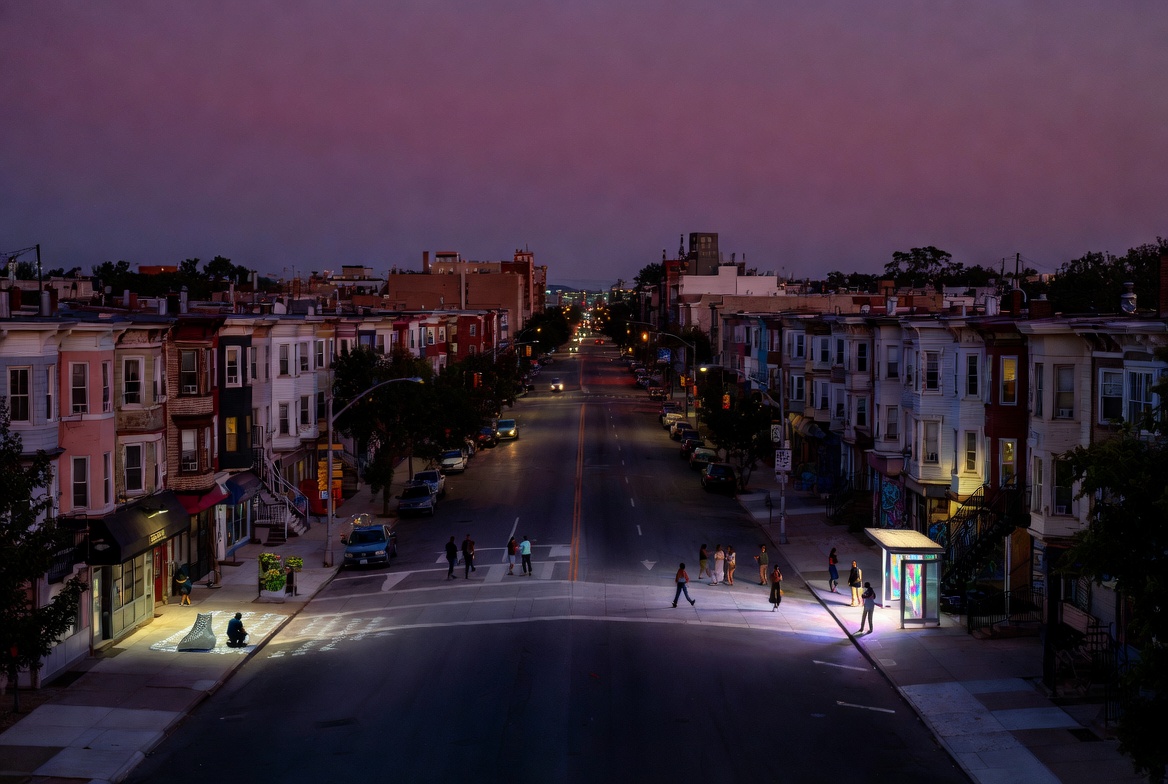
Community Poems Transform Germantown Public Art
By Darren Smith, Arts Reporter
April 8, 2026
PHILADELPHIA — Creative Philadelphia is set to unveil “Healing Verse Germantown: The Streets Are Talking” this Saturday, transforming 19 community-written poems into site-specific public art across one of the city’s hardest-hit neighborhoods. Backed by a $1 million Bloomberg Philanthropies Public Art Challenge grant awarded in 2023, the project converts verses born from loss into sidewalk etchings, sneaker sculptures, VR constellations, floral installations, and bus shelter stained-glass panels. Organizers call it healing. The timeline tells a different story: the works go up April 11 and come down by June.
The initiative began with 10 workshops between October 2024 and February 2025. More than 170 Germantown residents — many with direct experience of gun violence — produced over 200 poems. Nineteen were selected and handed to public art coordinator Rob Blackson for translation into temporary installations. Lead artists and former Philadelphia Poets Laureate Trapeta B. Mayson and Yolanda Wisher (a Germantown native) steered the process alongside trauma-informed facilitators. A parallel 24-hour poetry hotline (1-855-POEMRX2) has aired weekly verses since late 2024. The launch event at Friends Free Library on Germantown Avenue includes guided tours and activations at nearby Ubuntu Fine Art.
Gun violence statistics in Philadelphia provide uncomfortable context. City data and reporting from The Trace show homicides dropped sharply in 2025 to 222 — the lowest since 1966 — with early 2026 figures continuing a roughly 47% decline year-to-date. Officials and grassroots interrupters like Men Who Care of Germantown credit targeted policing, street outreach, and economic programs far more than cultural interventions. Yet Creative Philadelphia Public Art Director Marguerite Anglin frames the project explicitly around mental health: “We can’t just stop the gun violence on our own. Right? But we really want to address the mental health impacts of gun violence and teach community members… that art is a form of healing.”
Mayson echoes the therapeutic claim. “We met so many people who have lost family members, sons and daughters… So this Healing Verse Germantown project was critical because not only did it center and talk about the impact of gun violence in the community, but we also provided a way to heal.” Wisher has highlighted the workshops’ unexpected social byproduct: strangers bonded over shared grief rather than demographics. One participant, hip-hop artist and poet Andre Saunders, embedded his optimistic “Dreamers” directly into Germantown Avenue concrete. He hopes it signals possibility to local youth.
Those are sincere voices from inside the process. An independent Philadelphia violence-prevention organizer who works daily with at-risk youth and requested anonymity to protect city funding relationships offers a sharper assessment. “Individual catharsis is real for the poets who got stipends and exposure,” the organizer said. “But 19 temporary installations in one neighborhood for three months do not interrupt the economic abandonment, illegal guns, or repeat offenders driving the numbers. We’ve watched similar grant-funded art projects disappear after the ribbon-cutting, while the root causes stay.”
The $1 million grant — one of eight distributed nationally by Bloomberg — funds stipends for participants, fabrication, and coordination. It also burnishes the philanthropic and municipal brand: Creative Philadelphia and the Office of Arts, Culture and the Creative Economy gain visible equity credentials in a city still grappling with disproportionate impacts on Black and Brown neighborhoods like Germantown (population roughly 41,000). Mayson and Wisher, both established figures with prior laureate roles, receive fresh institutional spotlight. Community poets gain short-term validation and a handful of works may live on digitally or in a planned book. After June, the streets go quiet again.
In the broader 2026 art landscape, this fits a clear pattern. Private-market recalibration has cooled speculative sectors like NFTs and generative AI, pushing foundations and cities toward measurable “social impact” public art. Bloomberg’s challenge explicitly rewards civic-issue projects. The contradiction is structural: such funding rewards visible, time-limited gestures that photograph well for grant reports while systemic violence prevention demands sustained, unglamorous investment. No independent longitudinal study has yet tracked whether Germantown residents report lower trauma symptoms six months after the installations vanish. The data gap is telling.
The project does not pretend to replace policing or interrupters. It does claim space for grief and resilience in public view. Whether that claim survives the removal trucks in June will test whether this round of philanthropic public art was genuine community infrastructure or another polished symbol of concern.
Darren Smith is an Arts Reporter at Art Chain News covering contemporary art, digital art and NFTs, body art, and the intersections between these fields.
This article is based on direct examination of materials, market data, background interviews, and independent analysis.


