
Understanding the 2026 Art Market Through Larsen’s Auction
By Darren Smith, Arts Reporter
April 14, 2026
SCOTTSDALE, AZ — Bidding opened at 10:00 AM MST today at Larsen Gallery, 3705 N. Bishop Lane in Scottsdale, Arizona, for the spring 2026 edition of its biannual art auction. The house describes the sale as featuring more than 400 lots of fine art, including paintings, drawings, photographs, limited edition prints, and sculpture. Catalog listings indicate approximately 443–448 lots, depending on final tallies. In the context of the 2026 art market—marked by a modest 4% global growth to an estimated $59.6 billion in 2025 per the Art Basel and UBS Global Art Market Report 2026, alongside high-end concentration, online sales contraction, and continued recalibration—the emphasis on high volume prompts scrutiny: does this approach reflect renewed confidence or a defensive push for turnover in a segment where buyer selectivity has intensified and liquidity remains uneven?

Larsen Gallery, established in Scottsdale in the early 1990s, has positioned itself as a regional player offering accessible modern and contemporary works to Southwest collectors. The spring auction follows the house’s established pattern of large-scale events. Comparable prior sales include the 2025 spring auction, which realized approximately $1.47 million, and the 2025 fall auction at roughly $1.75 million. These totals reflect steady activity within the mid-tier secondary market but fall short of the headline figures generated by major international houses.
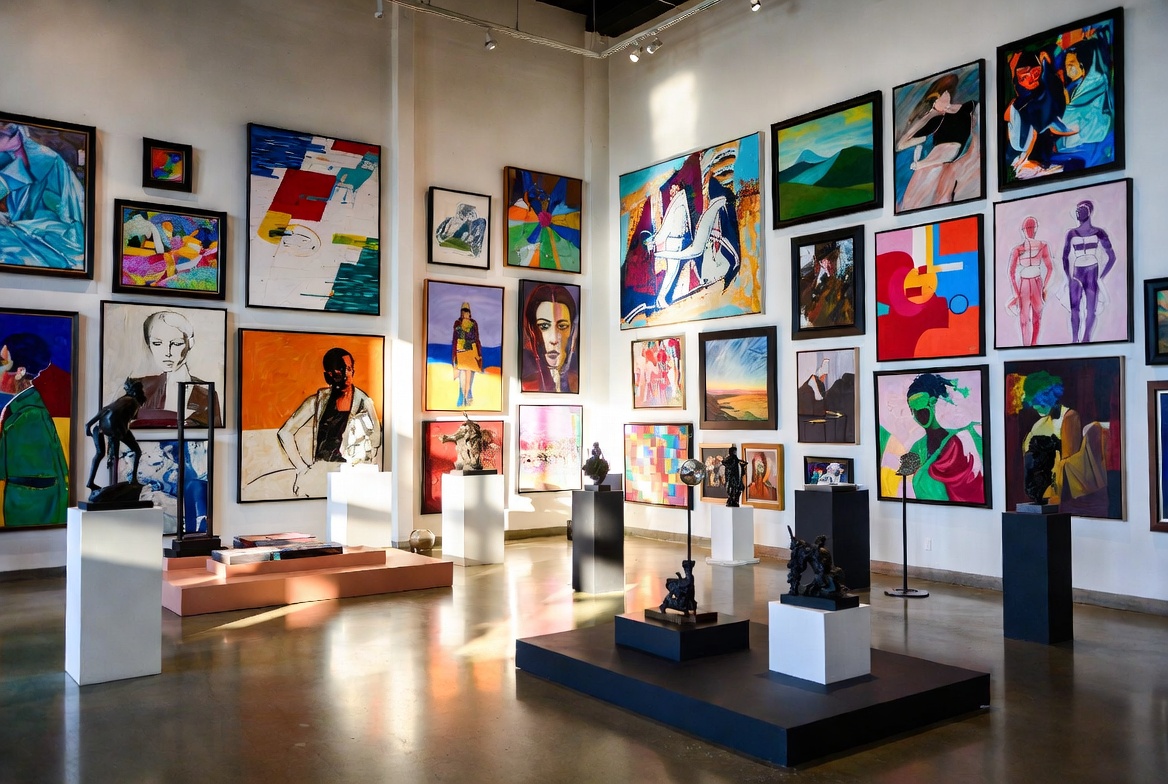
The auction proceeds with in-person, telephone, absentee, and online bidding options through Larsen’s platform, LiveAuctioneers, and Invaluable. Previews filled the gallery with densely hung walls and displayed sculptures, highlighting the logistical demands of presenting hundreds of works simultaneously.
Promotional materials consistently highlight “more than 400 lots.” Live catalog data points to around 443–448 works. Such volume is common in regional auctions, where houses aggregate consignments from estates, private collectors, and dealers to drive activity and offset fixed costs. Yet the strategy merits examination against 2025 market data. The Art Basel/UBS report records global art sales rising 4% year-on-year to $59.6 billion after two years of decline. Public auction sales grew 9% to $20.7 billion, while the dealer sector increased a more modest 2% to $34.8 billion. The United States dominated with about $26 billion (roughly 44% of global value), followed by the UK at $10.5 billion and China at $8.5 billion; these three markets accounted for 76% of total value. Online-only sales fell to $9.2 billion—the lowest since 2019—representing just 15% of overall market value and indicating a partial shift back toward in-person or hybrid channels where inspection and trust matter more.

Vara 1959
Oil on canvas
51.25 x 38.25 (in)
61.75 x 48.75 x 4 (in) framed
Signed and dated Saura 59, upper right
$100,000 – $200,000
Larsen’s catalog operates primarily in the mid-tier, with many estimates ranging from several hundred dollars to the low tens of thousands, though select pieces sit higher. Lot 290, Antonio Saura’s Vara (1959), an oil on canvas measuring 51.25 x 38.25 inches (framed 61.75 x 48.75 x 4 inches), signed and dated upper right, carries an estimate of $100,000–$200,000 and includes a certificate from the Antonio Saura Foundation. As bidding progressed, it attracted interest in the lower portion of the estimate range, consistent with cautious engagement seen across secondary markets early in 2026. Other offerings feature works by Yaacov Agam (kinetic and optical pieces), Laddie John Dill, and a broader mix of regional, decorative, and mid-career material.
A principal at a comparable Southwest auction house, speaking on background due to competitive sensitivities, offered a supportive assessment: “Auctions on this scale serve a practical role for collectors operating outside major international salerooms. The diversity creates opportunities to acquire works with secondary market presence at price points that may still allow room for appreciation as the market stabilizes.”

Two Mujeres, 1978
Charcoal on Strathmore paper
19 x 25 (in)
Signed and dated Zuniga 1978, lower left
$2,000 – $4,000
This view partially aligns with report findings on improving sentiment among larger dealers, where 45% of those with turnover above $10 million expected better conditions in 2026, up sharply from 19% the previous year. The report also notes strengthened representation of female artists, reaching 50% in primary market galleries and 45% across dealers in 2025—though secondary sales such as Larsen’s typically reflect available consignments rather than curated programming.
A veteran independent appraiser and former specialist at a major international auction house, with more than 15 years monitoring regional performance, provided a more critical perspective: “Catalogs approaching or exceeding 400 lots frequently serve as inventory management tools during recalibration periods. The decisive metrics remain post-sale sell-through rate, hammer price relative to low estimate, and buy-in percentage. Historical patterns in mid-tier auctions show sell-through rates often landing between 60% and 75% when supply significantly outpaces selective demand. Rising operational costs—venue, staffing, marketing, platforms, insurance, and shipping—can incentivize volume, but persistent high supply without corresponding depth in quality or provenance risks buyer fatigue and pressure on realized prices over multiple sales.”
Detailed public transparency on Larsen’s historical results is limited; the gallery directs specific inquiries to staff rather than releasing comprehensive post-sale breakdowns. The 2025 totals of approximately $1.47 million (spring) and $1.75 million (fall) indicate operational resilience in its niche, yet they contrast sharply with Sotheby’s 2025 performance: consolidated sales of $7.1 billion (up 18%), revenue of $1.4 billion (up 21%), and a $53 million pre-tax profit, marking a turnaround after prior losses and underscoring strength at the high end.
The 2026 market environment reveals clear contradictions. Aggregate growth has returned, yet the market remains approximately 9% below 2023 levels and smaller than its 2015 size in real terms. Recovery has been K-shaped: ultra-high-end lots and single-owner collections drove much of the auction rebound, while mid- and lower-tier segments faced ongoing caution amid elevated costs, geopolitical tensions, and selective buying. Collectors have grown more disciplined, prioritizing robust provenance, condition transparency, institutional context, and future liquidity potential.
In this setting, beneficiaries of a high-volume sale include consignors seeking regional liquidity channels with comparatively lower barriers than New York or London houses. Larsen earns via standard buyer’s premiums (typically tiered around 20–25%) and seller commissions on realized lots. Regional and mid-level collectors gain access without extensive travel or elite competition. Scottsdale’s broader ecosystem—including participation in events like Ferrari Art Week—provides contextual support through local collector networks and lifestyle appeal.

Estela (P. 239), 1977
Mixografía on Arches Paper ed. 36 of 100
29.25 x 22.25 (in)
39 x 32 x 1.5 (in) framed
Signed in white pencil R. Tamayo, lower right
$3,000 – $5,000
Nevertheless, promotional framing leaves several realities underexamined. The catalog blends stronger names with more decorative or variable secondary-market material whose long-term performance has been inconsistent. Full condition reports and provenance chains across hundreds of lots require diligent buyer review, which online or time-constrained bidders may not always complete thoroughly. Representation trends advancing at the primary level do not automatically translate to secondary supply. Technological features—such as enhanced digital provenance, blockchain elements, or NFT linkages—remain minimal; the sale stays anchored in traditional media.
Sector variations in 2025 further frame the sale. Impressionist and Post-Impressionist categories showed notable auction value growth in some segments, while postwar and contemporary areas experienced relative cooling after earlier peaks. The presence of kinetic, sculptural, and mixed-media works broadens appeal but risks diluting specialist focus in an environment where buyers increasingly favor “ironclad” examples with documented exhibition histories.
Operational realities for mid-tier houses add depth to the analysis. Competition comes from both international platforms and specialized regional sales (such as Western art-focused events in Scottsdale). Fixed costs have risen with inflation across shipping, insurance, staffing, and technology. Volume strategies can hedge against these pressures by increasing the statistical likelihood of sufficient sell-through. However, they risk a cycle where perceived quality dilution discourages stronger future consignments.
Transparency gaps persist across much of the regional sector. Major houses publish detailed post-sale statistics, including sell-through percentages and price indices; many smaller operations release only aggregate figures or selective highlights. This limits broader market analysis and can obscure whether headline activity masks softness in demand. For Larsen, the $1.5–1.8 million range in recent sales demonstrates consistency within its segment, yet scaling to nearly 450 lots tests demand elasticity in 2026’s selective climate.

Three Dog Day
Lithograph on paper ed. 20 of 100
31.5 x 30.5 (in)
36 x 35 x 1 (in) framed
Signed in pencil Anne Coe, lower right
$300 – $500
Cultural positioning also deserves note. Secondary market auctions facilitate circulation and price discovery but rarely shape primary discourse on representation, institutional critique, or emerging practices. Larsen’s offering remains traditional in focus, with limited intersection with digital, generative, AI, or body art practices. In a broader ecosystem debating technology’s role—from collector interest in new media to artist concerns over data use—such sales underscore the enduring role of analog formats.
Diversification through sculpture, glass, and mixed media aims to widen bidder pools, yet category performance has varied sharply. High-end concentration implies mid-tier participants often prioritize benchmarked names over experimental material. For consignors of mid-career or regional artists, inclusion brings visibility but carries the risk of unsold works affecting perceived market strength.
Looking ahead, the Larsen spring 2026 auction exemplifies structural dynamics in the current recalibration. Modest global growth signals stabilization rather than exuberance. Strength at the top coexists with pressures in the middle. Regional operations that prioritize transparent reporting, rigorous condition and provenance standards, realistic estimates, and accountable post-sale data may build enduring collector trust. Those depending heavily on volume may function more effectively as clearing mechanisms than as drivers of cultural or value leadership.
Post-sale results—expected in the coming days or weeks through gallery channels or bidding platforms—will offer concrete indicators via sell-through rates, price performance against estimates, and buy-in levels. Early activity on standout lots such as the Saura suggests measured participation. Over the longer term, mid-tier success will hinge less on catalog size and more on alignment with buyer priorities: quality over quantity, trust over transaction volume, and strategic positioning amid fragmentation.
The 2026 art market is not monolithic. It rewards selectivity at the high end, experimentation in primary channels, and disciplined execution across tiers. High-volume regional auctions like this one illuminate the mechanics and tensions of the middle ground—where supply strategies confront selective demand, regional accessibility meets global polarization, and operational necessities test broader recovery narratives. As post-sale data emerges and the year unfolds, performance metrics will help clarify whether such events support genuine liquidity and value formation or primarily reflect ongoing adjustment in which supply frequently tests the boundaries of refined demand.
Darren Smith is an Arts Reporter at Art Chain News covering contemporary art, digital art and NFTs, body art, and the intersections between these fields.
his article is based on direct examination of auction materials and catalog, the Art Basel and UBS Global Art Market Report 2026, historical sales data from public platforms, Sotheby’s financial disclosures, and background interviews with industry participants conducted on and off the record.
