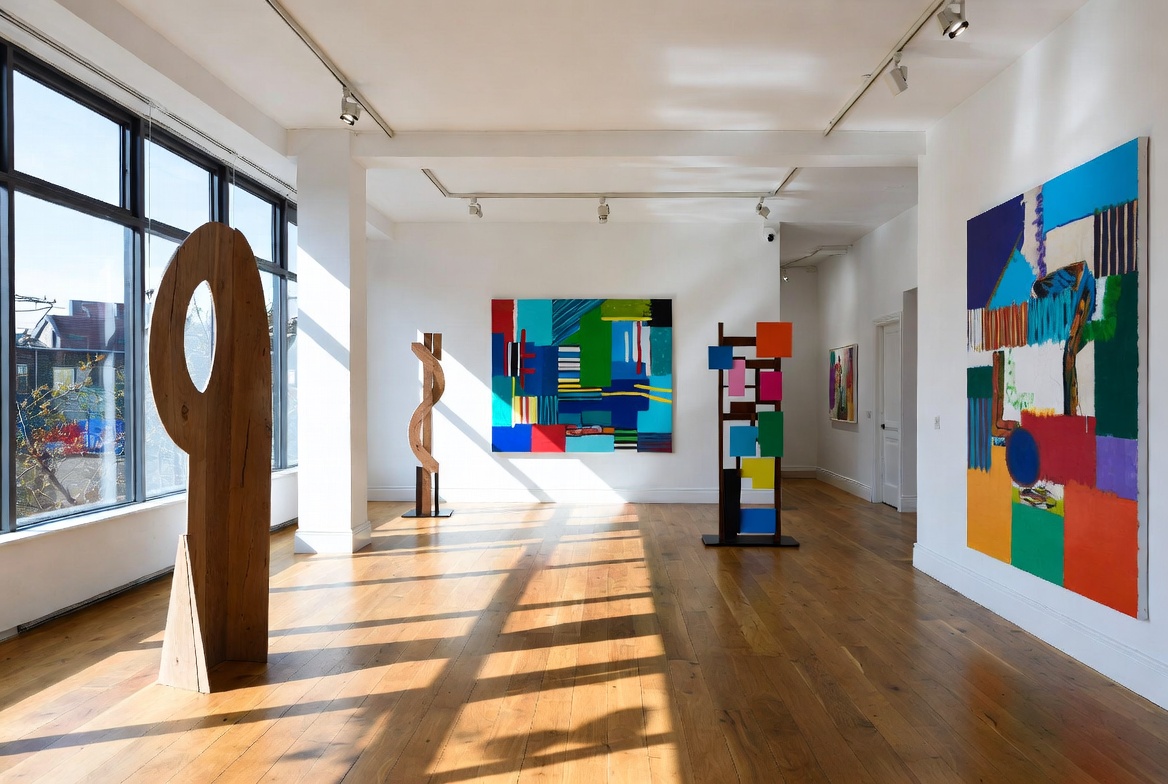
Bending Time: A New Exhibition in Hackney Celebrating Art
By Darren Smith, Arts Reporter
May 1, 2026
In the vibrant East London district of Hackney, a new cultural beacon has emerged that bridges decades of artistic defiance and rediscovery. The Prokofiev Studio at 13 Ramsgate Street officially opened its doors this week, dedicated to the life and work of Oleg Prokofiev (1928–1998), the Russian-born artist, sculptor, and poet whose abstract visions once challenged the iron grip of Soviet cultural orthodoxy.
The inaugural exhibition, titled “Bending Time,” runs through May 29 and transforms the former industrial space into a living archive. It features rarely seen paintings from Prokofiev’s early career in the 1950s—works long presumed lost or hidden due to their deviation from state-mandated socialist realism. These meditative compositions, with their organic forms and subtle explorations of light and rhythm, now take center stage alongside reconstructions of the artist’s later Hackney Wick studio from the 1990s.

Oleg Prokofiev was born in Paris to composer Sergei Prokofiev and his wife Lina. The family returned to Moscow in the 1930s, where the young Oleg studied at the Moscow School of Art. While his father navigated the treacherous politics of Stalinist cultural policy, Oleg forged his own path in the post-war years. By the 1950s, he had joined a small underground circle of abstract artists rejecting the rigid doctrine that demanded art serve the state—clear, figurative depictions of heroic workers and socialist progress. Abstract experimentation was risky; many works were destroyed, confiscated, or concealed.
“His paintings were acts of quiet rebellion,” notes one curator involved with the new studio. Prokofiev’s early abstractions, often executed in muted palettes with layered textures, emphasized inner contemplation over propaganda. After emigrating to the United Kingdom in 1971, he settled in southeast London and continued evolving his practice. His later output incorporated vibrant colors, rhythmic lines, and sculptural forms—organic constructivist pieces that echoed both his Russian roots and new British surroundings. He passed away in 1998, leaving behind a body of work that has gained renewed appreciation in recent years, including placements in the Tretyakov Gallery in Moscow.
The Prokofiev Studio initiative stems from efforts by the artist’s estate and supporters to preserve and contextualize this legacy. The space not only displays artworks but reconstructs elements of Prokofiev’s working environment, inviting visitors to engage with the archive as a “living, generative system” rather than static relics. Group elements in “Bending Time” incorporate contemporary responses, fostering dialogue between Prokofiev’s era and today’s artistic conversations.
Hackney’s artistic community has warmly embraced the opening. The area, long a hub for creative practitioners, provides a fitting home for an artist who found creative freedom in exile. Private viewings on April 30 drew collectors, curators, and admirers eager to witness these “lost” works.

Art historians view the studio as more than a gallery. It serves as a corrective to historical narratives that sidelined non-conformist Soviet artists. Prokofiev’s story mirrors broader struggles under authoritarian regimes, where creativity became a form of survival and protest. His poetry, often intertwined with visual practice, further enriched this multidimensional output.
Visitors to the studio will encounter a thoughtfully curated environment. The exhibition layout guides viewers chronologically and thematically—from suppressed Moscow abstractions to liberated London experiments—highlighting themes of time, memory, and cultural displacement.

This launch arrives at a moment of heightened interest in Eastern European modernisms. With global attention on cultural repatriation and hidden histories, the Prokofiev Studio positions itself as a vital research and exhibition hub. Future programming promises deeper dives into the artist’s sculptural innovations and poetic intersections.
Oleg Prokofiev’s journey—from Parisian birthright to Soviet constraints and British reinvention—embodies the resilience of the artistic spirit. The new London space ensures his abstractions, once whispered in defiance, now resonate openly. As “Bending Time” unfolds, it invites reflection on how art bends not only form but the arcs of history itself.
For more on the artist’s legacy, explore the official Oleg Prokofiev website.
Plan your visit to Prokofiev Studio today—admission is free, and “Bending Time” runs only through May 29. Support independent art spaces by sharing this story or attending an event. Discover more hidden artistic histories and become part of the conversation.
The hero/cover image above was generated using Grok Imagine, xAI’s AI image model, under editorial direction to visually represent the Prokofiev Studio exhibition in a factual and atmospheric manner.


